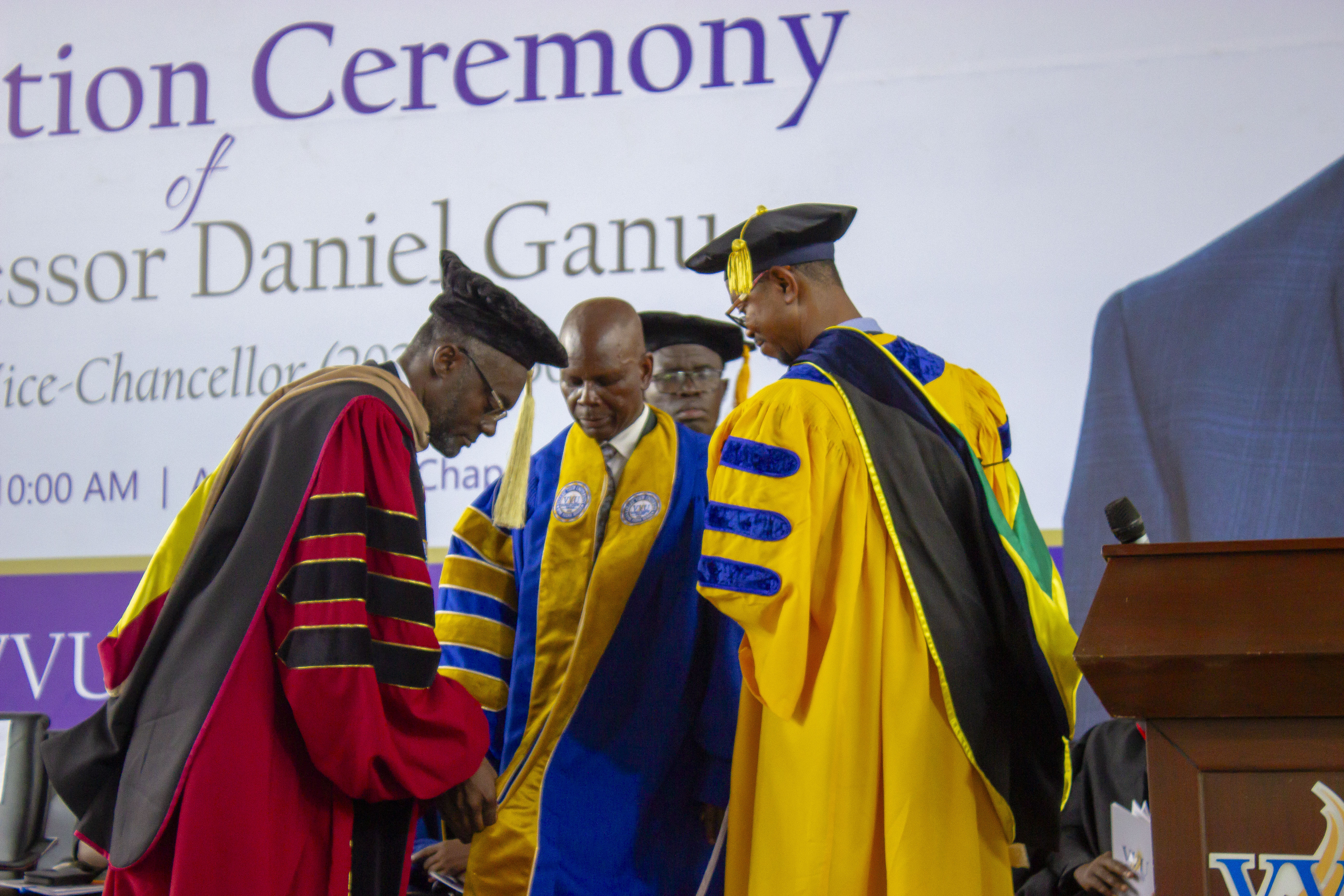
The induction of Professor Daniel Ganu as Vice Chancellor of Valley View University on Sunday, 19th April 2026 was not merely a ceremonial transition—it was a carefully articulated moment of institutional reflection, national relevance, and collective expectation.
From the opening prayer to the final benediction, we experienced a ceremony deeply anchored in our identity as a faith-based institution. The spiritual tone was unmistakable. In a powerful invocation, the officiating minister framed the office of Vice Chancellor not as administrative, but as “a spiritual trust,” calling for wisdom, humility, courage, and a firm commitment to preserving our Adventist identity. This framing echoed throughout the event: for us, leadership is not only about governance; it is about stewardship.
The formal structure of the ceremony, led by the Registrar, reminded us all of the weight of the office. The Vice Chancellor, as outlined, is not only the academic and administrative head but the chief disciplinarian, the strategic driver, and the custodian of our mission. In that context, the oath taken by Professor Ganu was particularly striking, an extensive pledge that emphasized humility, accountability, institutional loyalty, and a commitment to place the good of the university above personal interest. It was less a ritual and more a binding declaration of intent.
The presence of high-profile dignitaries underscored the national importance of the occasion. Representing the Office of the President, Marietta Agyeiwaa Brew, Presidential Legal Counsel and Chair of the University of Ghana Governing Council, delivered a keynote address that elevated the ceremony beyond institutional boundaries. Speaking on behalf of the Chief of Staff, she emphasized that “leadership matters” and warned that institutions do not fail suddenly, but gradually, when leadership loses clarity and courage. Her message was both affirming and cautionary: this appointment is a vote of confidence, but also a call to disciplined, value-driven leadership.
She further reminded us that a Vice Chancellor is “not simply a manager of systems but a steward of values,” a statement that captured the essence of the expectations placed on this new administration. In her view—and in ours—the success of Valley View University will depend not on one individual, but on a shared institutional commitment to standards, mission, and character formation.
From government, Hon. Clement Abas Apaak, Deputy Minister of Education, reinforced the broader national context. His remarks acknowledged the Vice Chancellor’s vision and described this moment as “not just a formal transition of leadership, but a renewal of purpose.” He emphasized that universities today must go beyond producing graduates—they must shape thinkers, problem-solvers, and ethical leaders. Notably, he affirmed the fairness of Professor Ganu’s call for the extension of the government’s “No Fees Stress” policy to private universities, signaling a willingness to engage with the concerns raised.
At the community level, Hon. Joseph Akuerteh Tetteh, Member of Parliament for the Kpone Katamanso Constituency, brought the discussion closer to home. His remarks were practical and grounded—highlighting our role within the constituency and commending the discipline and moral training we instill. His message was simple but significant: institutions like ours are not isolated—they are deeply embedded in their communities, and our success directly impacts local development.
Traditional leadership also found voice through representatives of the Oyibi community, who emphasized partnership, mutual respect, and shared growth. Their message reinforced an often-overlooked reality: universities do not exist in isolation; they thrive in relationship with their host communities—and we recognize that responsibility.
Perhaps the most defining moment of the ceremony, however, came from the Vice Chancellor himself. In a speech marked by clarity, realism, and conviction, Professor Ganu rejected any notion of ceremonial leadership. He acknowledged the pressures facing modern universities—technological change, financial constraints, rising expectations—and warned that institutions that fail to adapt risk decline.
Yet his message was not one of alarm, but of structured commitment. He outlined a clear leadership agenda built on mission-centered governance, academic excellence, institutional strengthening, financial sustainability, staff empowerment, and strategic partnerships. More importantly, he emphasized unity—warning that institutions are weakened by internal division but strengthened when stakeholders “pull in the same direction.”
His remarks on school climate were particularly compelling. Citing data on bullying and student safety, he expanded the definition of discipline beyond misconduct to include respect, belonging, and institutional culture. It was a reminder to us all that academic excellence cannot exist without a healthy learning environment.
In a bold and strategic move, Professor Ganu also used the platform to make a national appeal—for the inclusion of private universities in government tuition support initiatives. By grounding his argument in data and national contribution, he positioned our institution not just as a beneficiary, but as a partner in Ghana’s educational development.
What ultimately distinguished this induction ceremony was the coherence of its message. From the pulpit to the podium, from government to community, from council to Vice Chancellor, we witnessed a single narrative emerge: leadership must be purposeful, values must be preserved, and progress must be collective.
This was not a ceremony of empty rhetoric. It was a convergence of voices—each reinforcing the same truth: the future of Valley View University will depend on disciplined leadership, institutional unity, and an unwavering commitment to our mission.
As the ceremony concluded, one thing became unmistakably clear. The induction of Professor Daniel Ganu was not the climax of an achievement.
It was the beginning of accountability.